Yeonnam-dong Botox Column :: Sio Clinic's Standards for Botox Procedures

Yeonnam-dong Botox Column
Sio Clinic's Standards for Botox Procedures
Hello, this is Sio Clinic in Yeonnam-dong.
A clinic's consultation room is a space where vast amounts of data and the deep concerns of patients intersect every day.
As a doctor, my greatest challenge goes beyond simple injection techniques; it is about correcting the vague anxieties and misconceptions patients hold with medical facts to achieve the desired results.
Today, I would like to delve into a topic that patients frequently mention when diagnosing themselves: 'Botox resistance,' from the perspective of a practitioner.
<Director's Column on Botox>
01. On the resignation of
"Botox doesn't work for me"
02. The truth of clinical data: The boundary between
'True resistance' and 'False resistance'
Reinterpreting failure: 3 decisive variables
that block effectiveness
03. Sio Clinic's solution: Why we are obsessed with
'Pure Toxin' and 'History'
4. Rediscovered effectiveness,
the sophisticated difference hidden behind it
5. Treatment focused on the essence,
Sio Clinic's promise
1. The resignation of "Botox doesn't work for me"
I would like to start by sharing the case of a patient who visited our Yeonnam-dong clinic recently. As soon as she sat down in the consultation room, she let out a deep sigh and said:
"Doctor, when I got it done three or four times at other places before, the results were quite good. But at some point, no matter how strong the dose, it's not like it used to be. I think I have a constitution that has developed Botox resistance. Should I just give up now?"
For patients, the word 'resistance' often acts as a mechanism for giving up. It is a resignation mixed with despair that there is no way to improve anymore.
However, my perspective as a practitioner is a bit different.
Whenever a patient says, "I think I have resistance,"
it actually triggers my competitive spirit,
and I ask myself:
'Is this truly due to the body's biological antibody formation,
or is it the result of uncontrolled variables
in the procedure design and process?'
In reality, from a medical standpoint, encountering a patient with 'true resistance' in a clinical setting is extremely rare.
According to literature, the percentage of patients who actually develop antibodies after botulinum toxin treatment is very small. Nevertheless, we must dig into the fundamental reasons why so many people complain about a lack of effectiveness.
2. The medical reasons why we are fooled by 'false resistance'
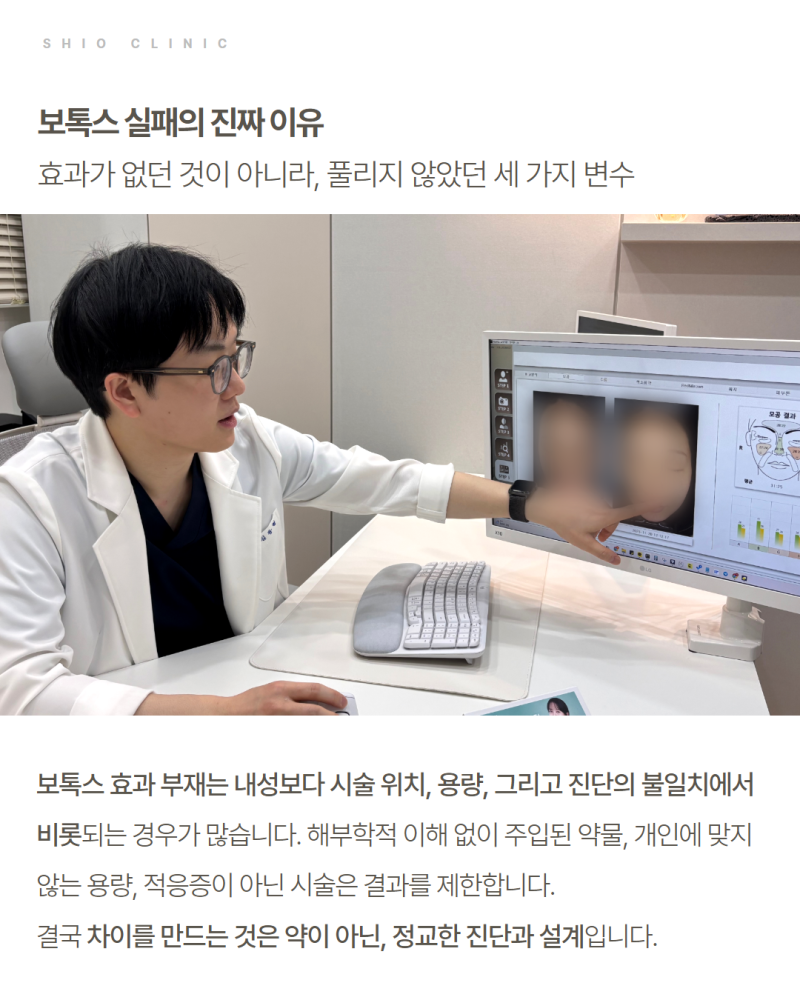
When we feel that the effectiveness has decreased, we first suspect drug resistance, but in reality, it is overwhelmingly likely that the following 'procedural variables' have acted in combination.
A. Failure to target the anatomical layer
Muscles are not a single mass.
The superficial layer and the deep layer have different directions of movement and different intensities of force. For example, to treat glabellar lines, the medication must reach the exact location and depth of the corrugator supercilii muscle.
However, if injected at a uniform depth without anatomical understanding, the medication will diffuse into the surrounding fat layer or unintended muscles rather than the target muscle.
As a result, the muscle movement remains the same while the medication is wasted, and the patient perceives this as 'it doesn't work (it's resistance)'.
B. Errors in dosage design caused by 'factory-style prescriptions'
The muscle mass and resistance of our bodies vary from person to person.
Some people may have highly developed masseter muscles, requiring more than double the standard dose, while others may find a very small amount sufficient. However, standardized factory-style prescriptions like '50 units for square jaw Botox' result in 'under-dosing' that is far from enough for some.
A procedure that does not exceed the sufficient threshold leads to minimal results, which is not resistance, but merely a 'failure of design'.
C. Discrepancy between diagnosis and prescription
When a patient visits with concerns about wrinkles, we must distinguish whether those wrinkles are due to excessive muscle movement or due to skin elasticity loss and sagging caused by aging.
Deep static wrinkles that have already become fixed or wrinkles caused by sagging skin cannot be solved by Botox alone.
In this case, no matter how much Botox is injected, there will be no dramatic change, so the patient suspects resistance, but in reality, it is a case where other solutions such as lifting or fillers should have been combined.
3. Why Sio Clinic is obsessed with 'Pure Toxin' and 'Procedure History'
To prevent true resistance (antibody formation), the practitioner's principles must come first. The two core values that Sio Clinic never compromises on in the consultation room are as follows.
First, the complete removal of complex proteins.
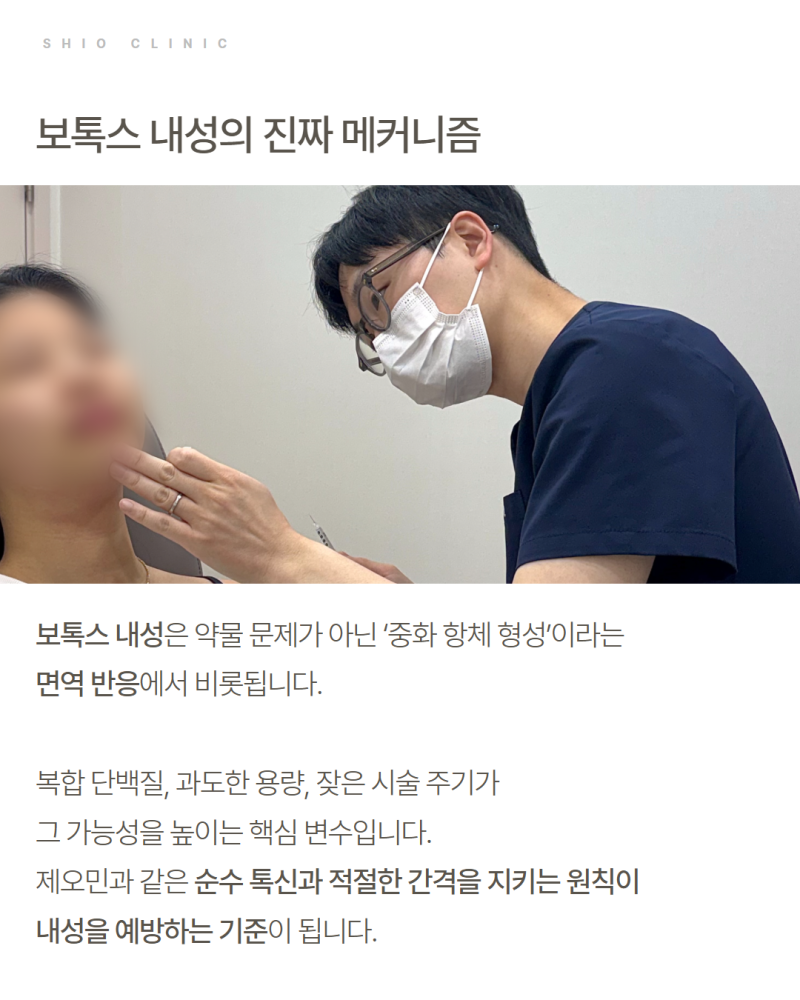
Botulinum toxin products contain inactive complex proteins surrounding the actual neurotoxin component.
Our body's immune system recognizes this 'complex protein' as an external invader much more strongly than the toxin itself.
In other words, the more protein impurities there are, the exponentially higher the probability of antibody formation.
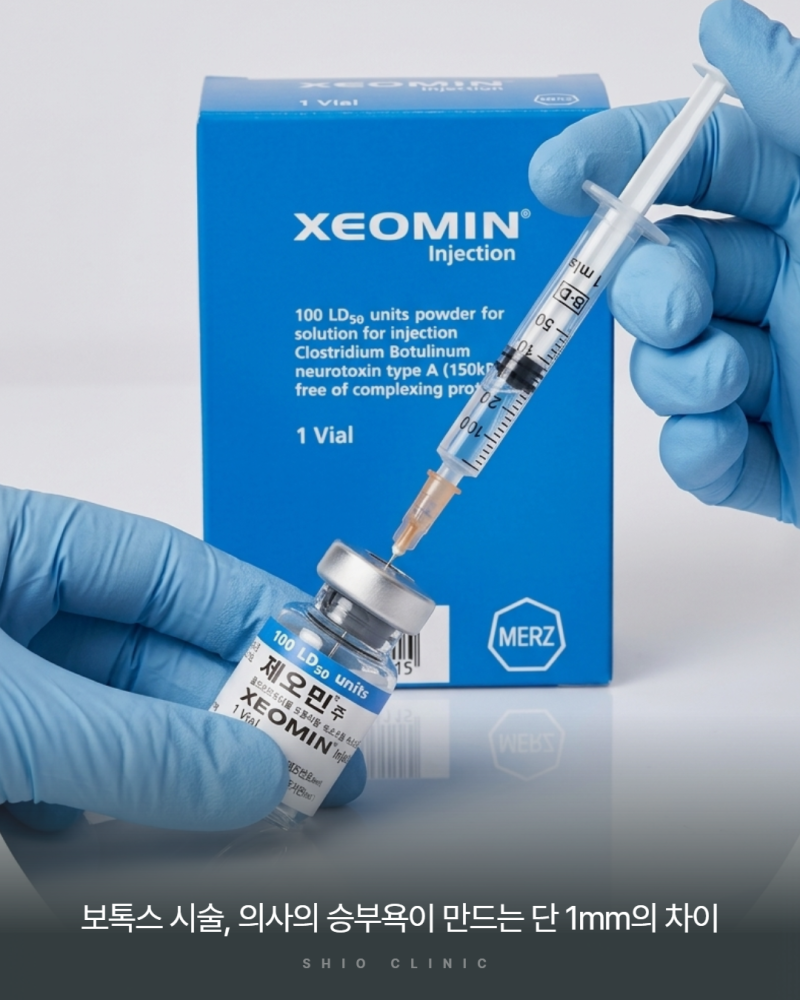
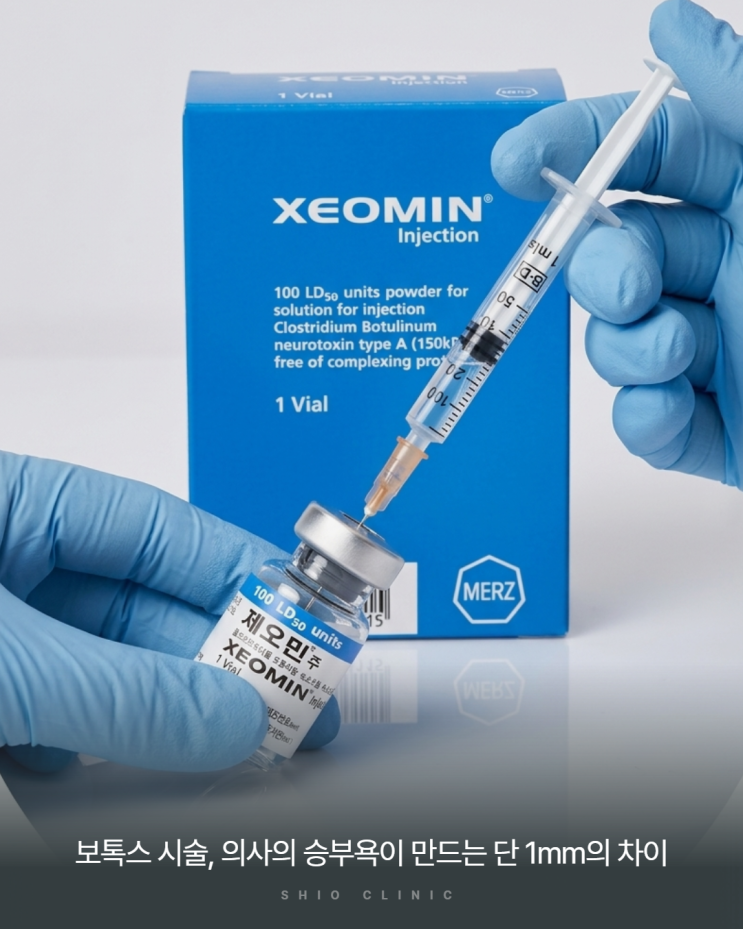
The reason our Sio Clinic prioritizes high-purity toxins like Xeomin is to precisely remove unnecessary proteins so that we do not give our body any reason to trigger a defense mechanism (antibodies).
Second, precise management of 'procedure intervals' and 'cumulative dosage'.
Resistance does not occur from a single procedure.
Too frequent intervals (e.g., repeated procedures at 1-2 month intervals) and excessive high doses injected at once are the most dangerous factors that stimulate immune cells.
Sio Clinic in Yeonnam-dong digitizes the procedure history of every single patient. We precisely analyze which product was used, where it was injected, and how much, to ensure a 'safe gap period'.
Our philosophy is not to indiscriminately increase the number of procedures for immediate profit, but to design a healthy beauty plan so that you can enjoy the benefits of Botox even 10 years from now.
4. Rediscovered effectiveness, the sophisticated difference hidden behind it
To the patient mentioned earlier who had resigned herself, saying, "It won't work because I have resistance," I said this:
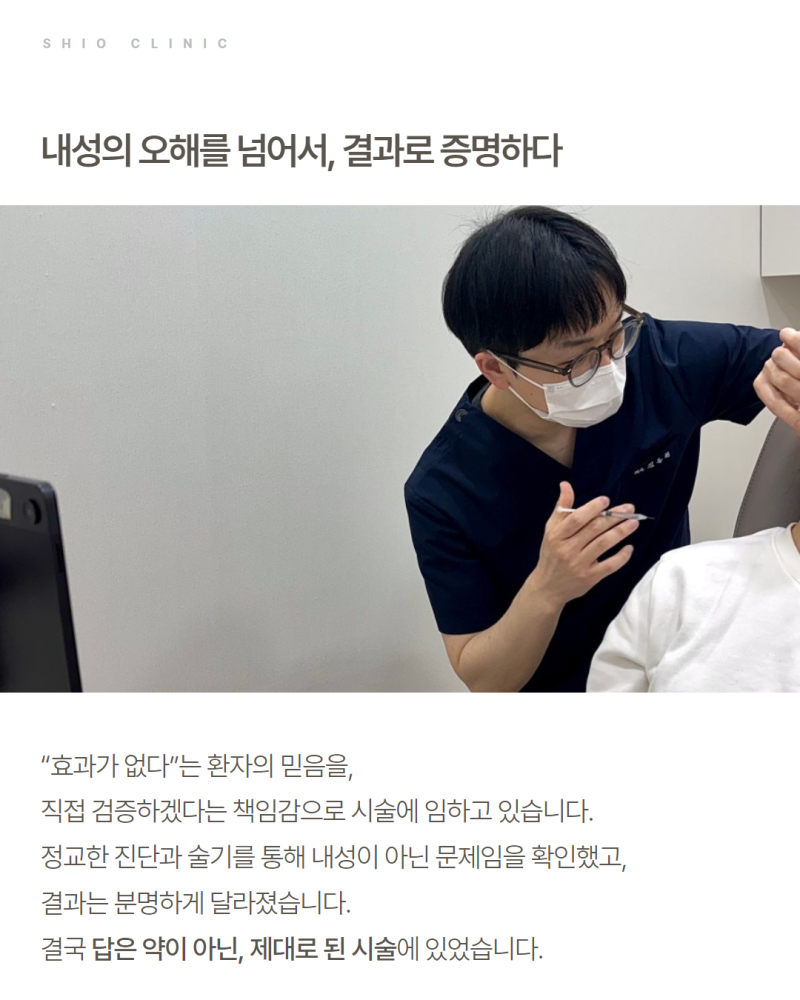
"Ma'am, I will personally verify whether this is truly physical resistance or if you simply haven't encountered a proper 'precision design' until now."
What was the result?
I felt that if it really didn't work, I wouldn't even want to charge for the procedure
(Of course, I did charge...)
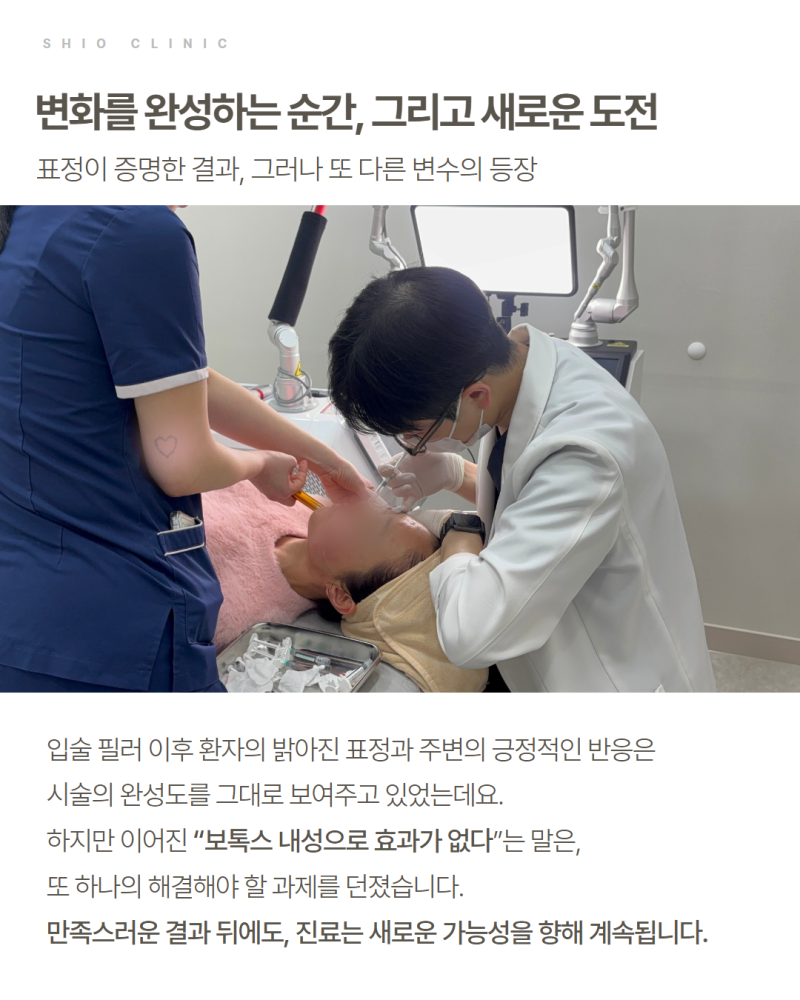
The patient's expression when she returned 2 weeks after the procedure was completely different from before.
"Doctor, I didn't have resistance after all. I can feel the muscles being controlled and the wrinkles smoothing out just like before!"
This patient had been receiving injections at the wrong depth or with insufficient dosage all this time.
Once the appropriate dosage was injected into the anatomical location, the dramatic effect inherent to Botox reappeared. This is the power of medical facts.
5. Treatment focused on the essence, Sio Clinic's promise
A doctor's role does not stop at simply providing aesthetic improvements.
Our reason for existence lies in not deceiving patients by saying something is possible when it is not, communicating honestly about medically possible areas and limitations, and proving results through verified methods.
If you have been stressed every time you look in the mirror, hiding behind the massive misunderstanding of resistance, I hope you will put an end to that concern at Sio Clinic.
We will help you maintain your beauty by reducing immune stimulation with high-purity toxins, precisely targeting every muscle fiber with 1:1 anatomical design, and managing intervals based on data.